
Dynamic Digital Radiography
A painless diagnostic test that records real-time, full-motion X-ray imaging of any body joint in motion — revealing dynamic injuries conventional imaging can't see.
A New Standard in Diagnostic Imaging
Dynamic Digital Radiography is a painless diagnostic tool that records real-time, full-motion X-ray imaging of any body joint while it moves. Think of it as an X-ray movie of your body in motion rather than a single still frame. Conventional X-rays and MRIs are static snapshots: they show the joint in a single position, usually while you're holding completely still. The problem is that many soft-tissue and ligament injuries are only visible when the joint is actually moving under load — and traditional static X-ray, CT, and MRI can miss them entirely, particularly in the neck and cervical spine.
Dynamic Digital Radiography changes that. Capturing roughly 30 exposures per second, it shows the joint moving through its full range of motion in real time — the only way to see many of the injuries that static imaging completely misses. That lets Dr. Busch pinpoint exactly where the problem lies and which therapies will best correct it, all at considerably less radiation exposure than a standard X-ray. It's a revolutionary diagnostic tool that has transformed care for people living with chronic, undiagnosed pain.
See Dynamic Digital Radiography in Action
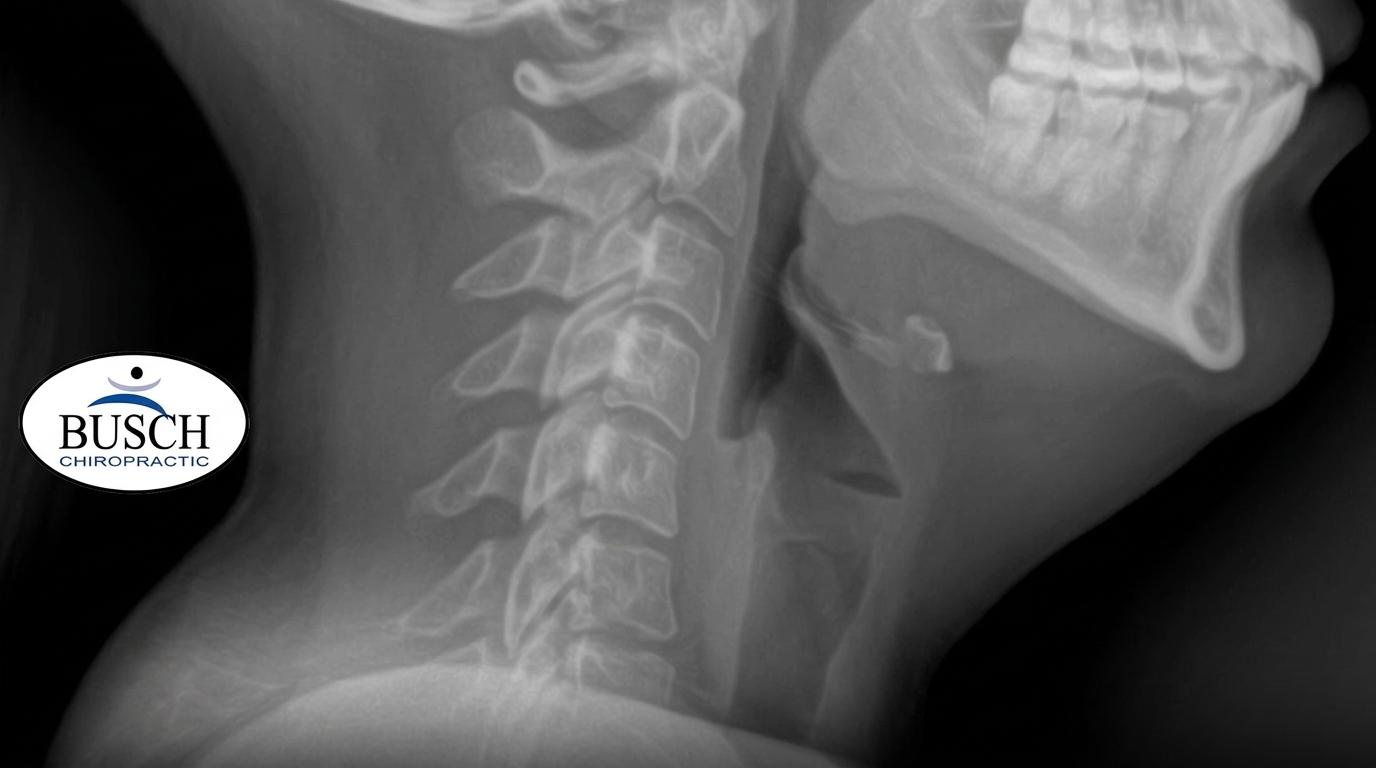
Real motion studies captured at Busch Chiropractic. Click through the clips below to watch each one — every clip plays silently.
Cervical Spine — Lateral
1 / 7
What Dynamic Digital Radiography Reveals
- Soft tissue and ligament damage that conventional imaging misses
- Dynamic joint instability — joints that look normal at rest but move abnormally under stress
- Whiplash-related cervical injuries that don't show up on standard films
- Whether permanent damage exists from a past injury
- Documentation evidence for personal injury cases
For patients whose pain has been written off as "everything looks fine on imaging," Dynamic Digital Radiography often reveals the real story for the first time.
Dynamic Digital Radiography vs. MRI
If you hurt more when you move, then it makes sense to be diagnosed while you are moving — and that's the fundamental difference between Dynamic Digital Radiography and an MRI.
Dynamic Digital Radiography images you in a standing, weight-bearing position, evaluating your bones and ligaments while they are actually in motion. This lets Dr. Busch see how your spine behaves under load and determine precisely which areas have been injured.
An MRI, by contrast, is designed to evaluate injuries while you lie still. But the upper 30% of the spine, along with the back (posterior) portion of the spine, contains no discs at all — only ligaments. Pain in this region is commonly caused by stretched ligament injuries, and those injuries often cannot be detected by an MRI, CT scan, or traditional X-ray.

Is Dynamic Digital Radiography Right For You?
Consider Dynamic Digital Radiography if you experience any of these:
- Pain in one or more joints that worsens with movement
- Joint injury from sudden impact, trauma, or whiplash
- Joint pain of undetermined origin despite conventional X-rays or MRI results
- Persistent pain after an injury that "shouldn't have caused" lasting damage
- A sense that something is wrong with how a joint moves, even though imaging looked clean
- An auto accident case where accurate documentation matters
Dynamic Digital Radiography can be especially revealing if you experience persistent neck pain during movement, headaches, dizziness, mental fogginess, fainting, tinnitus, POTS (Postural Orthostatic Tachycardia Syndrome), or EDS (Ehlers-Danlos Syndrome) — symptoms frequently tied to cervical instability and ligament damage that conventional imaging overlooks.
What You Gain From a DDR Evaluation
- You'll finally know the real reason you're still in pain.
- The right treatment plan for healing your injury can be determined — built around what the imaging actually shows.
- An accurate diagnosis and effective plan help you heal faster and get back to a pain-free life.
How It Fits Into Your Care Plan
Dynamic Digital Radiography is a diagnostic tool, not a treatment in itself — but the information it provides is essential for building an accurate care plan. Patients evaluated with DDR often come away with a clearer understanding of their injury than they've ever had before. From there, our team designs a treatment plan tailored to what the imaging actually shows.
Frequently Asked Questions
Dynamic Digital Radiography is a painless diagnostic tool that records real-time, full-motion X-ray imaging of a joint while it moves — think of it as an X-ray movie of your body in motion rather than a single still frame. Capturing roughly 30 exposures per second, it shows the joint moving through its full range of motion, which is the only way to see many injuries that static imaging completely misses.
A conventional X-ray is a single still image taken while you hold completely still, so it only shows a joint in one fixed position. DDR captures the joint in continuous motion under load, revealing soft-tissue and ligament injuries and joint instability that only appear when the joint is actually moving. It does this at considerably less radiation exposure than a standard X-ray.
An MRI evaluates injuries while you lie still, but DDR images you standing and weight-bearing while your bones and ligaments are actually in motion. This matters because the upper 30% of the spine and the back portion of the spine contain no discs — only ligaments — and stretched-ligament injuries in those areas often cannot be detected by MRI, CT, or traditional X-ray. If you hurt more when you move, it makes sense to be diagnosed while you are moving.
No. Despite capturing full motion at roughly 30 exposures per second, Dynamic Digital Radiography actually involves considerably less radiation exposure than a single standard X-ray. It gives Dr. Busch far more diagnostic information at a lower radiation dose.
Not at all. DDR is completely painless and non-invasive. You simply move the affected joint through its normal range of motion while the imaging is captured — there are no needles, no dyes, and no enclosed tube to lie inside.
DDR reveals soft-tissue and ligament damage that conventional imaging misses, dynamic joint instability (joints that look normal at rest but move abnormally under stress), whiplash-related cervical injuries, and whether permanent damage exists from a past injury. It can also provide documentation evidence for personal injury cases.
Very often, yes. For patients whose pain has been written off because everything looked fine on static imaging, DDR frequently reveals the real story for the first time. Because many ligament and soft-tissue injuries only show up under motion and load, an X-ray or MRI taken at rest can easily miss the source of persistent pain that DDR then uncovers.
Consider DDR if you have joint pain that worsens with movement, a joint injury from impact or whiplash, pain of undetermined origin despite prior X-rays or MRI, or a sense that a joint moves wrong even though imaging looked clean. It can be especially revealing for persistent neck pain, headaches, dizziness, mental fogginess, fainting, tinnitus, POTS, or EDS — symptoms often tied to cervical instability and ligament damage.
DDR is a diagnostic tool, not a treatment in itself — but the information it provides is essential for building an accurate care plan. Once the imaging shows exactly where and how a joint is injured, our team designs a treatment plan tailored to what the imaging actually reveals.
You will finally understand the real reason you are still in pain, and Dr. Busch can determine the right treatment plan built around what the imaging actually shows. An accurate diagnosis and an effective, targeted plan help you heal faster and get back to a pain-free life.
Call Busch Chiropractic at (260) 471-4090 and our team will help you determine whether Dynamic Digital Radiography is right for your situation and get you scheduled. If your pain has gone undiagnosed despite previous imaging, a DDR evaluation is often the clearest next step.